

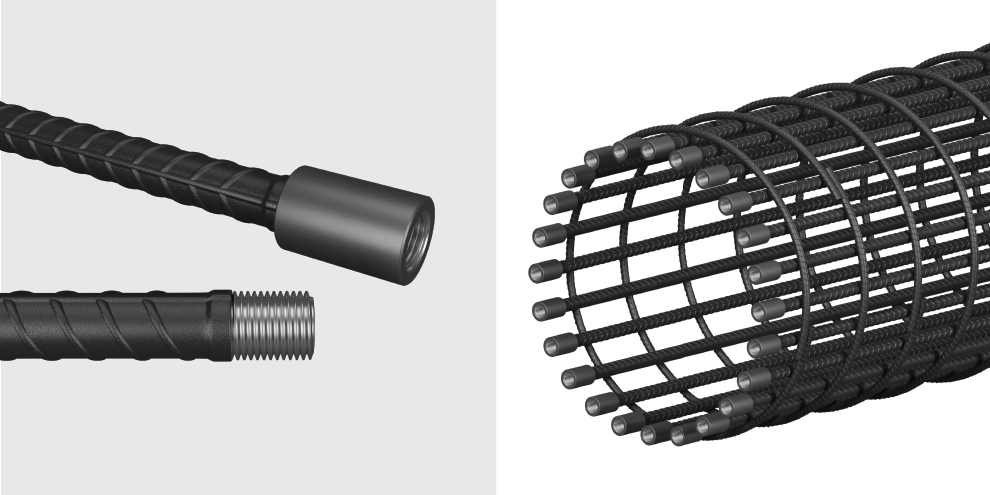
Reinforcement continuity is crucial for structural integrity in concrete construction. When a single continuous length of rebar cannot be used, splicing becomes necessary to maintain the strength and load-bearing capacity of the reinforcement system. The two primary approaches to rebar splicing, mechanical coupling and traditional lap splicing, offer different advantages and limitations that significantly impact construction efficiency, structural performance, and project economics. This article comprehensively compares these methods to help engineers and contractors make informed decisions for their project requirements.
Fundamentals of rebar splicing
Before examining specific methods, it’s essential to understand what makes an effective splice. A proper rebar connection must:
- Transfer the entire tensile and compressive forces between bars
- Maintain structural integrity under cyclic loading conditions
- Provide adequate ductility for seismic applications
- Resist environmental factors that could compromise performance
- Meet building code requirements for the specific application
Performance comparison
- Tensile strength development – Mechanical splices typically develop 100-125% of the bar’s specified yield strength, providing complete continuity under tensile loads. Lap splices, particularly in larger bars or congested areas, may develop less than full tensile capacity if concrete consolidation around the splice is compromised.
- Cyclic loading – Modern mechanical splicing systems designed for seismic applications offer superior ductility and fatigue resistance compared to lap splices. This becomes particularly important in regions with high seismic activity, where structural elements must withstand repeated load reversals during earthquake events.
Griptec mechanical couplers undergo stringent testing, verifying their capability to withstand repeated loading while maintaining strength. This reliability makes these systems particularly valuable for critical structural elements where performance predictability is essential. The engineered design of these couplers ensures consistent force transfer regardless of installation variables that might affect lap splice performance.
Economic considerations – Beyond material costs
While lap splices appear less expensive when considering only material costs, a comprehensive economic analysis reveals a more complex picture:
Labor efficiency
Mechanical splicing typically requires less installation time, particularly in congested areas. Reduced labour hours can offset higher material costs, especially in regions with high labour rates.
Schedule impact
Faster installation of mechanical splices can accelerate construction schedules, reducing project overhead costs and allowing earlier project completion and revenue generation.
Concrete requirements
Lap splices increase the effective reinforcement density in spliced regions, sometimes necessitating changes in concrete mix design or additional formwork to accommodate the congestion. These factors add hidden costs to the more straightforward method.
Application-specific selection criteria
The optimal splicing method depends on specific project conditions:
- Seismic regions – Mechanical splices are often preferred or required in seismic design categories D, E, and F, particularly for critical elements like columns and shear walls.
- High-rise construction – The space efficiency of mechanical splices becomes particularly valuable in high-rise structures where reinforcement congestion at column-to-column connections can create significant construction challenges.
- Precast connections – Mechanical splices offer advantages for connecting precast elements, allowing for field adjustments and reliable force transfer across joints.
Both lap splicing and mechanical coupling have legitimate applications in modern construction. While lap splices remain appropriate for many routine applications with smaller bar sizes and non-critical elements, mechanical splicing systems offer significant advantages for complex structures, critical components, and projects where space constraints or schedule considerations are paramount.
The selection process should consider initial material costs, installation efficiency, schedule impacts, structural performance requirements, and project-specific constraints. Identifying these factors helps engineers and contractors choose the splicing approach that best meets their unique project requirements.